


French Court to Rule on Recognition of Nicaragua’s $800 Million Pesticide Ruling
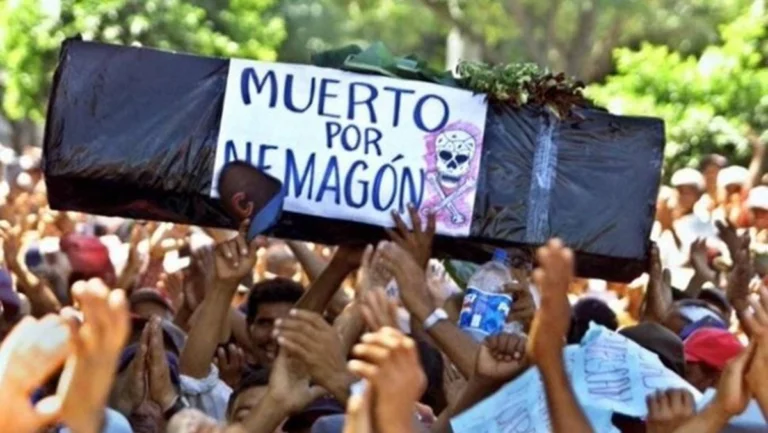
The sign displayed at a protest reads, “Dead by demagogon.” X/ @lamesaredondan1
November 18, 2025 Hour: 2:16 pm
🔗 Comparte este artículo
Former banana workers accuse three U.S. companies of fraud to evade compensation.
On Tuesday, the Paris Court of Appeal announced that it will issue a ruling on February 17, 2026, regarding the recognition in France of a judgment against three U.S. companies.
RELATED:
Nicaragua greets the Russian people for National Unity Day
In 2013, Nicaragua’s judiciary ordered those firms to pay US$800 million in compensation for poisoning 1,246 banana harvesters with pesticides. The Paris hearing took place after an appeal filed by the Nicaraguan farmers, following a first-instance decision in France in 2022 that ruled against their claim.
Attorneys for the former banana harvesters accused Dow Chemical, Shell Oil and Occidental Chemical of “fraudulent maneuvers” to prevent enforcement of the Nicaraguan ruling related to contamination from the pesticide Dibromochloropropane (DBCP), at least within French jurisdiction.
In 2013, Nicaragua’s judiciary determined that agricultural workers from the Chinandega region exposed to DBCP — banned in the United States since 1979 but still used in several Latin American regions — had suffered various cancers, sterility and organ damage due to the pesticide.
Meanwhile, lawyers for the companies challenged the impartiality of the Nicaraguan ruling as well as the integrity of its judicial system, adding that the case is now time-barred.
In this extraordinary case, notable for its international scope and procedural complexity, plaintiffs seek recognition of the final Nicaraguan judgment under the “principle of exequatur,” which is a legal procedure that allows a foreign judgment or arbitral award to be recognized and enforced in another country. Such recognition would pave the way for enforcement in other European Union countries where the U.S. companies still hold assets.
“We hope that the suffering of these humble people will finally be recognized and compensated,” said David-Olivier Kaminski, an attorney for the Nicaraguan plaintiffs, as he presented photographs of affected workers to the court’s president. According to him, one-third have already died, while those who remain alive were unable to attend the hearing.
According to estimates submitted by the plaintiffs before the hearing, the initial US$800 million in compensation set by the Nicaraguan courts could now rise to around US$2 billion with interest.
“We are talking about massive fraud, with fake victims and fake testimonies,” countered one of the defense attorneys, who reiterated that the case is time-barred under Nicaraguan law because more than 10 years have passed since the original ruling issued in 2006.
The plaintiffs’ lawyers dispute that argument, asserting that no statute of limitations applies because Nicaragua’s Supreme Court upheld the ruling against the three companies in 2013, and the exequatur request was filed in France in 2018 — a legal procedure normally used in divorce cases.
Defense attorneys also challenged some of the alleged health effects of the pesticide, suggesting they were exaggerated, and placed responsibility for improper handling of the chemical on the employers of the banana workers, thereby absolving the companies that manufactured it.
In 2022, the Paris Judicial Court sided with Dow Chemical, Shell Oil and Occidental Chemical, ruling that they were entitled to be subject solely to U.S. jurisdiction, which removed Nicaraguan courts from having authority over the dispute.
teleSUR/ JF
Source: EFE